Railway Command Group
The Narrow Road to the Deep NorthThe Railway Command Group was the Japanese authority issuing operational directives for construction of the Siam–Burma Railway. Through changes to plans, deadlines, and labor assignments, it pressed the project forward despite shortages and deteriorating conditions; after the war, the railway was abandoned, dismantled, and gradually reclaimed by the landscape.
Mandate and Strategic Purpose
The railway was conceived as a way to move men and supplies by land between Siam and Burma. Japan, losing control of the seas and seeking to supply its forces in Burma, aimed to cut the route used by the Allies to supply Chiang Kai-shek’s army in China and to support its ambitions toward India. The Japanese High Command ordered construction in the shortest possible time, although the English and Americans had previously judged such a railway impossible. Its planned route was marked by surveyors’ pegs along a line of 415 kilometres from north of Bangkok toward Burma.
The Railway Command Group operated within that larger project of urgent military construction. Its demands were imposed on a workforce that included prisoners of war and Asian laborers, while the project lacked the money and machinery needed for conventional railway building. The group’s planning therefore depended on assigning large quantities of manual labor to a task whose scale and timetable were already at odds with the available resources.
Directives and Engineering Demands
When Colonel Kota brought new orders to Major Nakamura, the Railway Command Group had changed the design of a major cutting that was already half complete. It required the cutting to be enlarged by a third to address gradient problems in the next section, adding another 3,000 cubic metres of rock to be cut and removed. The order arrived where prisoners were using hammers and chisels by hand; there were too few saws and axes, the chisels were inadequate, and a shortage of coke limited the ability to sharpen them. Nakamura’s suggestion that drilling machines and compressors would help did not produce a commitment of equipment.
The group also advanced the railway’s completion deadline from December to October. The revised date arrived in August, leaving Nakamura to confront a task he regarded as impossible. Colonel Kota could offer no assurance that machinery or tools would increase, and described additional labor as uncertain. The contrast between the newly compressed schedule and the unchanged scarcity of equipment made the command’s priorities tangible: the timetable could be tightened by order, while the material means to meet it remained absent.
A further directive required Nakamura’s camp to send one hundred prisoners to a camp near Three Pagoda Pass, about 150 kilometres north on the Burmese border. Nakamura objected internally that his own section needed more workers, not fewer. The order thus set the Railway Command Group’s wider allocation of labor against the immediate demands of a construction site already short of fit workers.
Labor Allocation and Camp Conditions
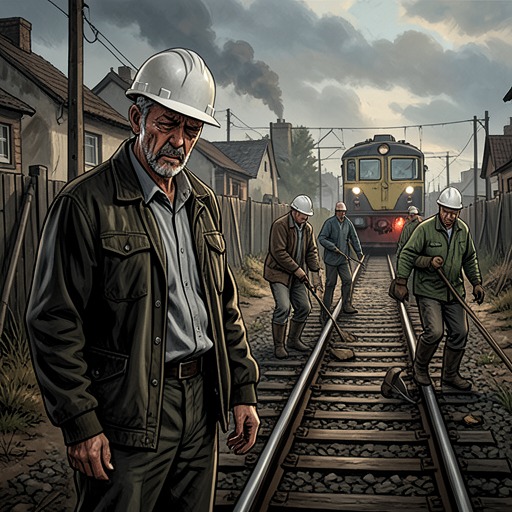
The Railway Command Group’s orders reached a workforce whose circumstances were worsening. As the monsoon arrived, food diminished and the Speedo began: rest days ended, quotas rose, and shifts lengthened, with prisoners increasingly assigned both day and night work. The project’s physical demands were carried out with hand tools and the prisoners’ labor, while hunger, illness, and exhaustion reduced the available workforce. Nakamura’s account of the site also records flooded rivers, impassable roads, dwindling supplies, and a cholera outbreak that diverted fit men from railway work. The Railway Command Group nevertheless expected him to accomplish more.
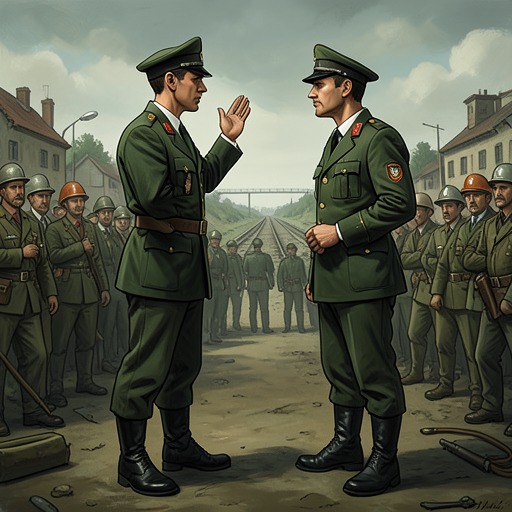
The consequences of labor demands also appear in the negotiations between Major Nakamura and Dorrigo Evans, the prisoners’ commanding officer and senior medical officer. Dorrigo reported that 838 prisoners remained: 67 had cholera, 179 were in hospital with severe illness, 167 could manage only light duties, and 62 more were reporting sick that morning. He calculated that 363 men were available for railway work. After further argument, he offered 400, grounding the figure in his medical assessment and warning that forcing more sick men to work would cost the camp workers who might recover. The exchange shows how demands for labor became a conflict over numbers, with medical judgment placed against the immediate requirement to supply workers.
Outcome and Legacy
The Railway Command Group’s directives belonged to a project that was completed under wartime pressure. On 25 October 1943, locomotive C 5631 travelled the length of the Death Railway, its first full journey, passing the remains of workers who had died during construction. The railway had joined sections of track, but its completion did not preserve the purpose for which it had been built: with the Japanese imperial project defeated, the line lost its support and military function.
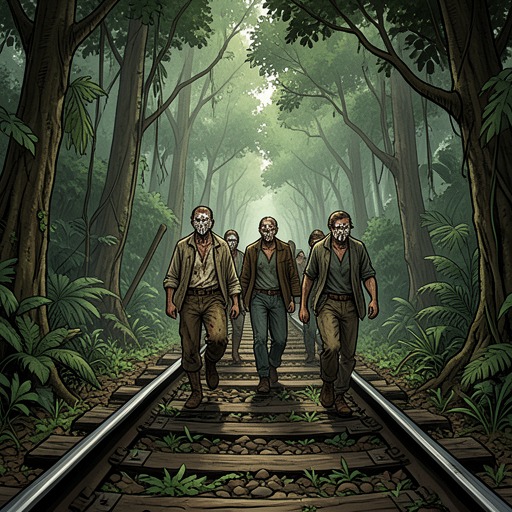
Within weeks of the war’s end, the railway began to disappear. The Thais abandoned it, the English dismantled it, and local people removed and sold sections; over time, embankments and bridges washed away and cuttings filled in. The Railway Command Group’s work had imposed a rigid route and timetable on labor and terrain, but the infrastructure proved temporary. The line that had been treated as an urgent instrument of imperial purpose was broken apart and gradually overgrown.